Work-life balance comes up often in my conversations with executives. I notice that most people treat it as a scheduling issue, a matter of organizing time better, when it is actually, first and foremost, a question of which brain is running your day.

Self-Knowledge and Clear Boundaries

The first step is self-knowledge: understanding your limits and what you can sustain without compromising your health or personal life. From there, it becomes easier to establish clear boundaries with people around you, at work or at home. That might mean deciding not to answer emails outside working hours, or protecting a nonnegotiable part of your day. A boundary only truly exists when you clearly understand what you are protecting.

Communicating this honestly is also part of the process. Talking openly with the person on the other side, whether an employer, business partner, or your own family, about your needs and limits prevents imbalance from becoming silent resentment. The key is to find an arrangement that works for both sides: not imposing, but negotiating clearly.

Presence, Not Just Time Management

Managing time well helps, but it is not enough on its own. In my work with executives and athletes, I find that most people already know how to prioritize tasks in theory. What is missing is the presence to carry out each task with full attention, rather than being in three places at once inside their own heads. That happens when the survival brain is in charge, responding to a late email as though it were a real threat: always alert, never fully anywhere.

Calm is not a personality trait some people are born with and others are not. It is a skill you train every day, one that naturally slips back into survival mode when you stop practicing.

Health and Mindful Disconnection

Caring for physical and mental health is another foundation that cannot be treated as an extra, something you do if time allows. Exercise, nutrition that supports your body, and moments of attention training all build the foundation that supports everything else. Without it, any attempt to find balance in other areas of life becomes fragile.

Mindful disconnection is where the difference becomes most evident. Leaving the office on time accomplishes little if your mind remains there, reviewing meetings, planning tomorrow, unable to switch off. That is the survival brain on autopilot, scanning for threats that have already passed. Defining times when you truly disconnect, without emails or work calls, is as much an exercise in presence as it is in discipline.

Finally, prioritizing your personal life means making quality time for family, friends, and moments that have no productivity goal at all, and truly being present for them, rather than physically there and mentally somewhere else.

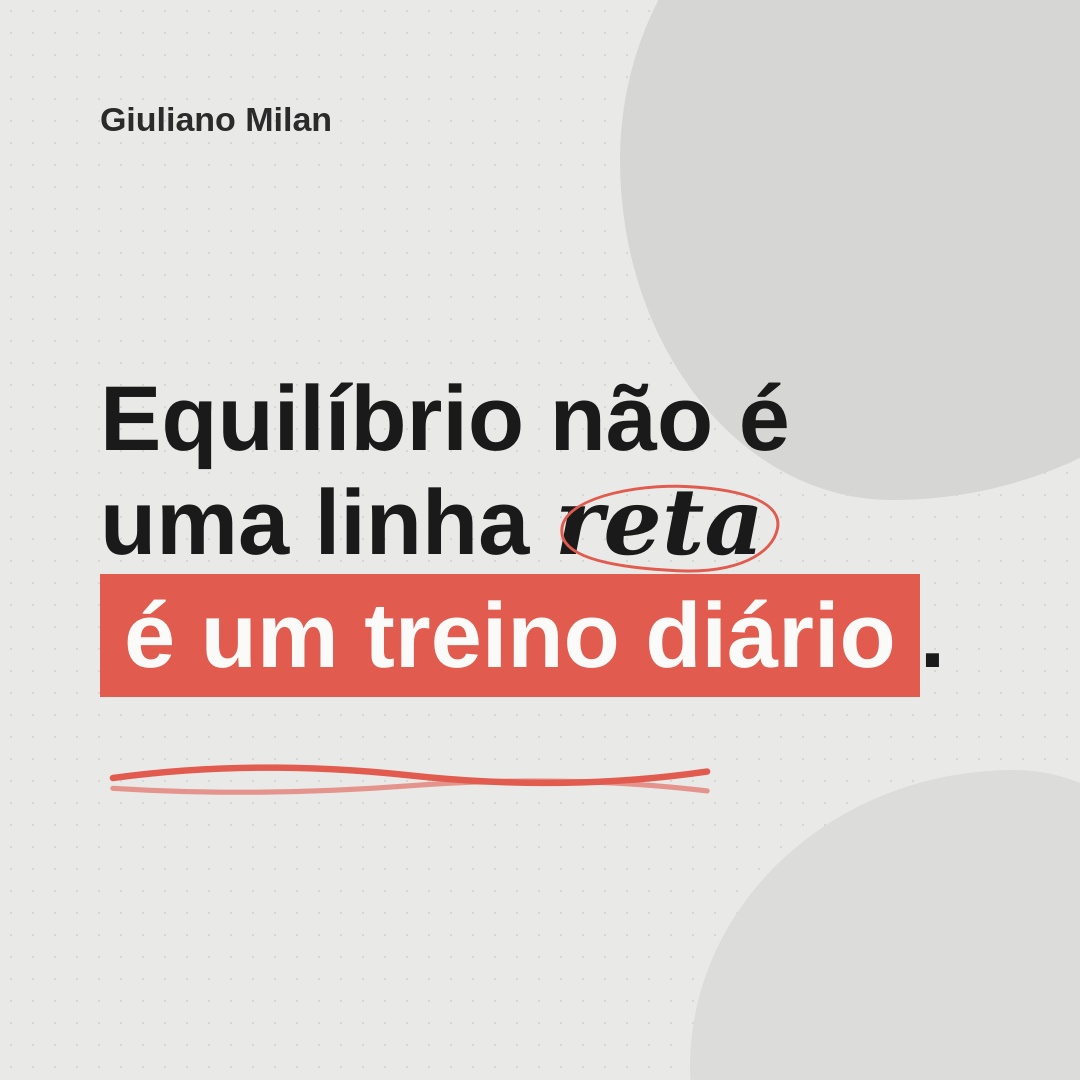
Ultimately, balance is not a straight line you reach and maintain forever. It is the daily practice of bringing your mind back, as many times as necessary.

Giuliano Milan
Jul 30, 2026
Work-Life Balance