
How to Build a High-Performance Mind, with Giuliano Milan
Program: Lugar de Potência | Host: Ricardo Basaglia (Basa), CEO of Michael Page in Brazil | Guest: Giuliano Milan, creator of the Milan Method for Building Presence, who has spent more than two decades translating contemplative practices into practical tools for clarity, presence, and performance under pressure | Published: November 17, 2022
Who Is Giuliano Milan?
Basaglia opened the show by introducing Giuliano as someone passionate about performance, the brain, and people. Giuliano began his career at 18 as an intern at Procter & Gamble, but soon recognized a gap in the market and began studying everything he could find about well-being, mental health, and performance. At 20, he left a promising career in marketing to better understand human beings, traveling to several countries to study meditation and creativity. Today, he mentors Olympic athletes, racing drivers, executives, and entrepreneurs. His clients have included Alok’s manager Gabriel Lopes, volleyball player Bruno Rezende (Bruninho), swimmer Thiago Pereira, and former XP partner Betina Roxo.
Asked whether he had shown unusual sensitivity toward other people even as a child, Giuliano agreed.
“I was always the class representative. I was the responsible student who would walk friends who had gotten into fights to the principal’s office, advising them along the way: ‘Come on, calm down, think, take a deep breath. Next time…’ I was already doing that when I was four or five.”
He explained that he started school a year earlier than usual because he would cry at the door when his brother went to school without him. As a result, he entered college at 16, turning 17.
Childhood Habits
Discussing the roots of that sensitivity, Giuliano recalled childhood habits that, he said, later became the foundation of his method.
“When I was five or six, I liked lying on the floor in my parents’ living room, putting on classical music, closing my eyes, and feeling the music’s vibrations. I remember entering mental states very similar to the meditative states I experience today.”
He described himself as an “unusual” child who woke up early on Sundays to watch Pequenas Empresas, Grandes Negócios, a Brazilian television program about business. In high school, he considered a diplomatic career because he was good at managing conflict and seeing both sides of a situation.
His Early Years in the Corporate World
At Fundação Getulio Vargas, which he said graduated only 150 students a year and had little comparable competition at the time, Giuliano studied with figures such as Guido Mantega and Henrique Meirelles. Seeing the unhappiness of successful people, including his own boss at Procter & Gamble, made him question his direction.
“I remember my boss had just had a daughter, and he went almost fifteen days without seeing her because she was asleep when he got home. He would say, ‘Wow, I haven’t seen my baby in fifteen days.’ I thought: that is not what I want for myself.”
“You work yourself to the bone for twenty years and then try to recover the happiness you lost over those twenty years. That makes no sense, does it?”
What Did You Learn in Each Place?
Basaglia asked what Giuliano had learned while traveling around the world to study the human mind. Giuliano returned to the book that changed his path in college, Creativity in Business, by Stanford professors, and described how difficult it was at the time to find meditation taught separately from religious traditions.
“It was as if meditation were a jewel embedded inside certain concepts and precepts. I felt as though I was using a machete to clear a path that didn’t exist, looking for ways to address quality of life that weren’t necessarily being taught at major universities.”
He took courses in Spain, the United States (in the Oregon area), and Canada, but emphasized that he never lost his connection to practical life.
“I never lost that connection with the practical, real world. I didn’t get into meditation and disappear or become a monk. I always had that practical, business-oriented side.”
How Do You See the World?
Asked about the brain’s tendency to feel pressured as everyday demands increase, Giuliano returned to his central subject: how the brain works. He mentioned Harvard-affiliated Indian physician Srinivasan Pillay, who studies fear and anxiety, and explained his view of the evolutionary logic of constant threat detection.
“It’s as though the human brain were the sum of neurological structures also found in other species. When you think about a species that scientists say is 150,000 or 200,000 years old, it is still a test species. It hasn’t yet become firmly established.”
“Our unconscious brain scans the environment twenty-four hours a day, looking only for threats, and operates in thirty to forty milliseconds. Our conscious brain, the one listening to this podcast right now, operates in about four hundred milliseconds. It’s ten times slower.”
He described three responses that he associates with this primitive system: freezing, fleeing, or fighting. In modern life, he argued, these can translate into disproportionate reactions to everyday problems.
“If you’re having trouble paying a bill or you’re late on your credit card payment, that’s the response it gives you: death. Your brain is constantly dealing with threats.”
Basaglia raised the role of social comparison and social media, noting that people are not taught self-knowledge and emotional management in school. Giuliano agreed.
“We are victims of that lack of knowledge. We learn nothing about emotional management. I didn’t learn it at home. My parents didn’t teach me to manage stress and anxiety. I didn’t learn it at school or at the best universities I attended.”
He also mentioned Daniel Pink’s book Drive to explain why today’s working world increasingly requires creativity as repetitive tasks become automated, and why excessive stress and anxiety are, in his words, major enemies of performance across fields.
The Importance of Early Childhood
Asked about the relative influence of genetics, environment, and learning on brain development, Giuliano returned to an argument he had made in other interviews: that much of the human brain develops after birth.
“We’re born with about half a kilogram of brain, on average, and before long we have a brain weighing one and a half kilograms. More important than giving your child Harvard, or extra time later, is giving them five years filled with support, love, presence, and peace. That makes all the difference in developing a healthier brain.”
He argued that developed countries should prioritize public investment in the first five years of life because, in his view, certain developmental windows do not recur.
How Can We Improve the Brain?
Basaglia asked which practical steps help build a “Super Brain.” Giuliano cited athletes he had worked with, including Bruninho, Lucão, Éder, and Lucarelli during preparations for the Rio Olympics, and swimmer Thiago Pereira ahead of London, where he competed against Michael Phelps in the 400-meter individual medley.
“As I said, our brain is one of the most intelligent machines, the machine that creates all the other machines, but it is focused on scanning for stress and anxiety. It’s as if it has a preference for stress and anxiety.”
He referred again to Daniel Pink’s book on human motivation and discussed the historical evolution of work, from slavery toward greater freedom of choice, as a parallel for understanding how safer environments can support creativity.
“When you increase freedom, that brain begins to perform better and become more intelligent, using energy more efficiently. But its bias is still strongly oriented toward stress and constant threat.”
Asked whether performance improvements last without ongoing practice, he was direct.
“If you stop for a week, it’s like stopping physical exercise: you lose your biceps, you lose muscle, because it isn’t the natural state. The natural state is anxiety and negativity.”
How Do You Leave Survival Mode?
Asked about tools for moving the brain out of survival mode, Giuliano identified meditation as his main approach and also emphasized contact with nature, whether real or represented visually.
“It’s as if meditation deactivates the amygdalae, which are activated twenty-four hours a day by all these modern stimuli. It’s no coincidence that the headquarters of American technology companies now resemble Disney theme parks, with waterfalls beneath your desk.”
“Our brain doesn’t know how to distinguish an image from something real. An image of a snake or spider will activate the brain just like a real snake or spider.”
Sleep, Nutrition, and the Myth of Productivity Without Rest
Discussing healthy habits, Giuliano described an “umbrella” approach in which no single practice is sufficient. He questioned the idea that people can remain productive while consistently sleeping too little.
“It’s a collection of actions. When you put these people behind the wheel and ask them to drive between cones, they hit them. What someone says they feel is not necessarily what is actually happening. Thinking you are fine and actually being fine are two different things.”
How Can You Maintain Focus?
Basaglia asked about the increasing difficulty of maintaining attention in an age of fragmented information. Giuliano replied that this, too, is a form of training, but in the wrong direction.
“Our brain is being trained to be multifocal and fragmented. Everything you do repeatedly trains your brain. If you’re here with me, looking at one thing and then checking your phone, you’re practicing that kind of divided attention, and your brain becomes specialized in it.”
He then demonstrated the exercise he teaches all his clients: counting breaths.
“Mentally, you go: inhale, exhale, one; inhale, exhale, two. The idea is simple. You don’t need to breathe more deeply. Count ten to fifteen breaths. Here’s the key: if you lose count, go back to zero. Every time you forget and return to counting, you’re building a neural pathway for greater focus.”
As an example of progression, he said Bruno Rezende took about a year to reach a deeper meditative state but can now meditate for half an hour with ease.
Mental Health
Discussing the growing visibility of mental health, especially after the pandemic, Giuliano made a point about burnout.
“Nobody develops burnout overnight. You don’t cure burnout with a vacation. That would be like saying, ‘I’ll eat all year and then go thirty days without eating.’ You can’t compensate that way. It’s about balance.”
“We are at the culmination of a period in human history that tried to ignore this, focusing on IQ and wealth while acting as though emotions did not exist.”
Changing Your Environment
Asked how to deal with toxic environments, whether at work or in the family, Giuliano avoided a simplistic answer.
“I think just calling something a ‘toxic environment’ can be superficial, because you also play a part in it. Nobody is only a victim. There is no perfect environment that will spare you from working on your brain to help it become more positive.”
“It’s easier to focus on getting your own brain out of that operating mode than to try to change your entire environment.”
Procrastination and Discipline
On procrastination, Giuliano offered an unconventional view: he believes it can indicate that an activity lacks meaning for the person or that the action plan is poorly designed.
“I don’t have to force myself to do anything because I love what I do. I think procrastination can be a very revealing signal about what you’re doing.”
“I know people who say, ‘I have to exercise at five in the morning, run every single day.’ Sorry, if I were an employee of that company, I wouldn’t like it. I’d be furious and I’d procrastinate. They’ve created a terrible action plan.”
He cautioned against reducing more complex problems to laziness or lack of discipline.
“Some people have mental and emotional health problems. Then you tell them, ‘You’re just lazy, you lack discipline.’ Imagine how that person feels. We want to know what the problem really is. You can’t take one isolated explanation and assume you’ve hit the mark.”
Intuition
Asked about intuition in his work, Giuliano described it as the product of exposure to many sources of information, not a mystical gift.
“You supply your conscious and unconscious minds with a great deal of information. In a meditative state, the brain organizes that information and gives me creative leaps.”
“Forcing it doesn’t solve the problem; it only gets in the way. It’s during daydreaming or meditation that you organize the ideas in your brain and arrive at a breakthrough, rather than thinking only about the problem.”
Ego
Discussing vanity and ego as people advance professionally, Giuliano returned to meditation and mentioned its effects on the anterior cingulate cortex, an area associated with compassion.
“It’s no coincidence that people who meditate can respond differently. In scientific tests, someone watches a horror movie and becomes anxious, while someone who meditates remains relaxed. I’m much more likely to find solutions that work for everyone than destructive solutions that seem good for just one person.”
Technical Knowledge Versus Emotional Skills
Asked why technical knowledge dominates professional education, Giuliano cited a figure from research by Michael Page, Basaglia’s company.
“Ninety-one percent of professionals are hired for technical skills and later fired for behavioral reasons. Yet we live in a world where less than one percent of MBA, undergraduate, graduate, and master’s-level modules focus on soft skills.”
He cited Italy, particularly educational approaches in the Emilia-Romagna region, as a reference for early childhood education focused on creativity and emotional development.
A License to Become a Parent?
Returning to a provocative argument he had made elsewhere, Giuliano suggested that parenting might one day be subject to stricter requirements.
“In the future, you won’t be able to become a parent whenever you want, just as you can’t drive simply because you believe you have the right to. You’ll need a license to be a parent. I’m absolutely certain that within a hundred years we’ll see parenting licenses with ongoing follow-up.”
“Why are we so concerned about driving a car, which can kill people, but less concerned about raising dysfunctional people who could harm many more?”
The ‘Red Hunter’ Segment
In this rapid-fire recruiting segment, a signature feature of headhunter Basaglia’s podcast, Giuliano described what he values when hiring someone for his team.
“I like to understand a person’s purpose in life: why they’re alive, what they’re doing, and what they want to do here. Very selfish people, people who don’t know how to work in a group, can undermine the whole team.”
He cited a lesson from volleyball coach Bernardinho about why individual technical talent does not make up for a toxic team environment.
“You may have someone who is sensational in a position, who attacks better than anyone, but in the locker room he irritates everybody and creates discord. That person has an enormous cost to your organization. He isn’t worth the points he scores.”
Optimism About the Future of Work
Asked about the future of emotional management in organizations, Giuliano expressed optimism. He compared resistance to mental health initiatives with past resistance to changes such as bans on smoking on airplanes.
“My grandfather died thinking it was absurd that he could no longer smoke on an airplane. People laugh when they hear that, but he lived in a time when pregnant women smoked and cigarette ads were associated with sports.”
He emphasized leadership’s role in changing organizational culture.
“When this wasn’t important to me, or wasn’t even on my radar, all I had to do was demand results. That was structurally easier. I often say companies are so focused on results that they forget to focus on what produces results.”
‘Dona Ângela’: Quick-Fire Statements
Invited to complete spontaneous sentences, Giuliano described laughter as a mental health tool and “a powerful mechanism for cooling down the brain.” He called himself “unusual because I talk about a subject people have never heard of.”
Recalling unusual moments in his career, he described his family’s reaction when he left a promising career to pursue meditation.
“My whole family thought I was sick, that I’d joined a cult, that I was using drugs. My grandfather thought I was on drugs. You leave a top university and a top company and say, ‘No, I’m going to focus on quality of life and meditation.’ In 1996 that made me a hippie. In 1998 I had no support, absolutely none.”
Lugar de Potência: Where Giuliano Feels Strongest
Referring to the podcast’s name, Basaglia asked when Giuliano feels he is in his own “place of power.”
“Even the highest levels of stress and anxiety don’t frighten me. I can manage those situations completely. I’m very good in moments of intense confrontation.”
Recognizing a Mentee’s Limits
Asked how to know how far to push a client without crossing healthy boundaries, Giuliano acknowledged that there is no fixed formula.
“That comes down to intuition and using your sensitivity to read the situation. There’s no formula for those moments.”
A Truth People Rarely Say
Invited to share an under-discussed truth about success, Giuliano was emphatic.
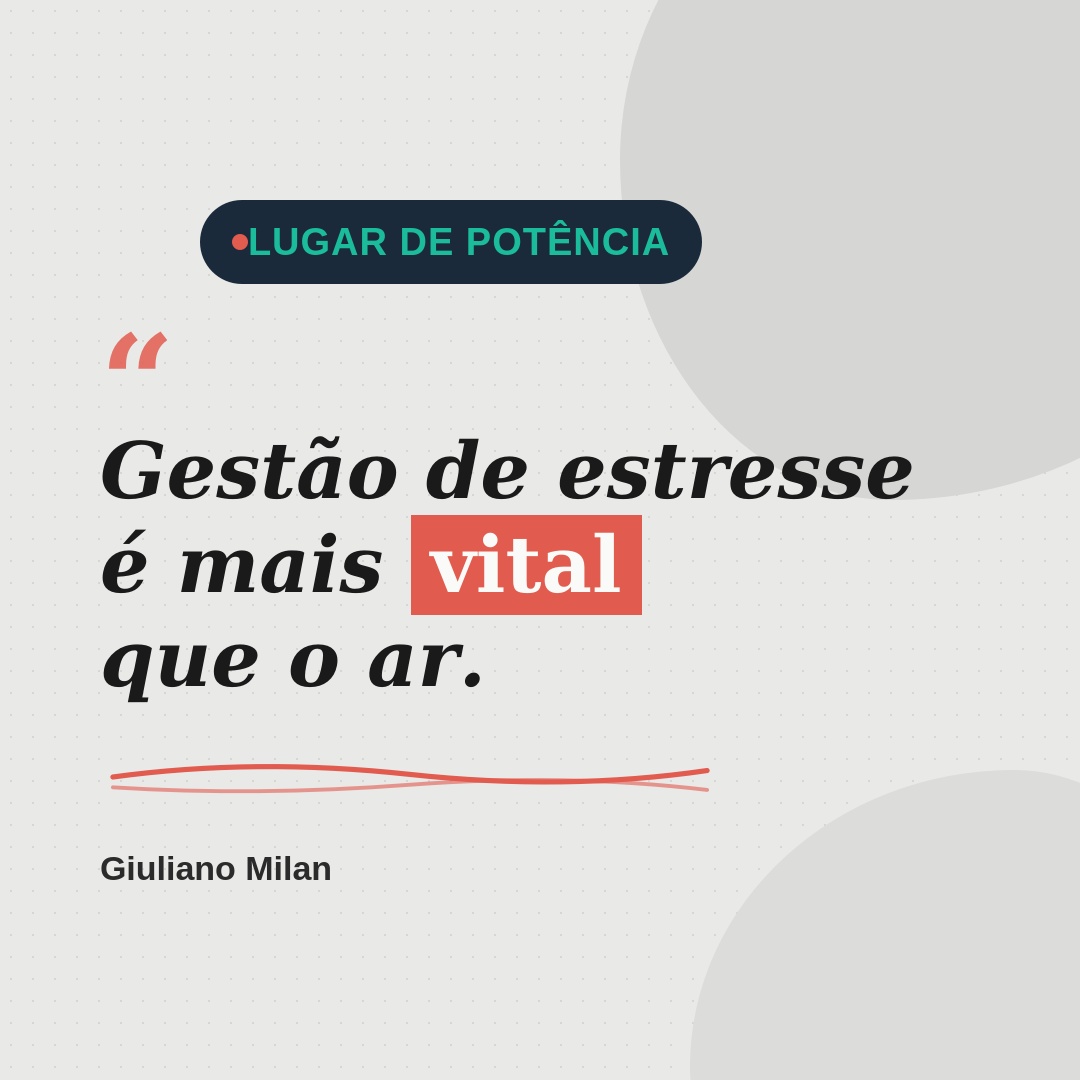
“Managing stress and anxiety is more vital than the air you breathe. You cannot live your life without thinking about this subject.”
He criticized the misconception that emotional intelligence means no longer feeling emotions.
“People often confuse emotional intelligence with being someone who feels nothing, someone above good and evil. They want to buy a psychological eraser to wipe away uncomfortable feelings. That doesn’t exist.”
Stoicism
Discussing Marcus Aurelius and Stoicism, Giuliano reflected on the enduring nature of human emotions.
“In two or three thousand years, these books will still feel completely current because these emotions will always exist. Fear and anger are human emotions. They are timeless.”
He returned to the idea that meditation allows people to observe a problem from a different level, citing a saying attributed to Einstein.
“It’s difficult to solve a complex problem at the same level where it was created. Meditation means lowering this activity and rising above it. From up there you can see the solution. It isn’t at the same level as the problem.”
Book Recommendations
Asked to recommend material for a future guest, Giuliano again mentioned Andrew Newberg, for his work on the neurological effects of faith, and Srinivasan Pillay, for his work on fear and anxiety. He also highlighted Edith Eger’s The Choice as one of his favorite books. He said he continues to research Holocaust survivor testimonies in public archives to better understand resilience and emotional recovery after trauma.
What Is Happiness?
To close the more philosophical part of the conversation, Basaglia asked Giuliano to define happiness. Giuliano referred to psychologist Rick Hanson’s Buddha’s Brain and described happiness as a baseline state that can develop through sustained practice.
“When I first began meditating, I would enter a state of happiness. After so many years of meditation, it’s as though that state has become constant. I carry it throughout my day. It’s a state of flow, a state in which you feel you have a purpose in life.”
“I feel fear, anger, and every other emotion, but that underlying happiness is still there. Once you build the super brain, it can give you a foundation of pleasant emotions to live with.”
Projects and Where to Find Giuliano Milan
To close, Giuliano mentioned his two music albums for meditation and sleep, available on Spotify and other platforms. He said he often plays them at home for his daughters and notices fewer conflicts when they play together. He also pointed to the Positivo Sua Mente YouTube channel, created with Bruno Rezende during the pandemic, and previewed plans for speaking engagements and immersive courses on the “Super Brain” method.
This interview appeared on Lugar de Potência, hosted by Ricardo Basaglia. Guest: Giuliano Milan, creator of the Milan Method for Building Presence, who has spent more than two decades translating contemplative practices into practical tools for clarity, presence, and performance under pressure.