
How to Get Your Brain Out of Survival Mode: Giuliano Milan on the Lutz Podcast
Program: Lutz Podcast #127 | Host: Lutz | Guest: Giuliano Milan | Published: February 9, 2023
Introduction: Where a Fascination With the Human Brain Began
Lutz opened the episode by inviting Giuliano to introduce himself and describe his work. Giuliano explained that his fascination with people and the brain began in adolescence.
“I have always been passionate about people. Even as a teenager, I wanted to understand how the brain worked and how we could make better use of it. That fascinated me.”
He recalled the pre-internet era, when the Brazilian magazine Superinteressante was one of his few sources of information about neuroscience. He entered Fundação Getulio Vargas (FGV) at around age 16 or 17, ranking highly on several college entrance exams. Unsure which profession to pursue, he chose business administration because he knew he wanted to work with people.
“I thought, since I don’t know exactly what I want to do, I’ll study business administration. Even if I choose the wrong path, at least I’ll learn how to manage something.”
At FGV, he encountered psychology, anthropology, and sociology. A book on creativity in business, written by two Stanford professors, changed his direction. Many CEOs interviewed for the book connected creativity with faith, spirituality, meditation, and yoga. That discovery inspired him to explore these subjects through a scientific lens.
Chapter 1: How to Enter a Meditative State
Giuliano described living in Canada and later Europe in the late 1990s while studying meditation, which at the time was closely associated with spiritual traditions such as Buddhism and Hinduism.
“Meditation sometimes comes packaged with changes in habits and beliefs. Its written history goes back more than 2,000 years, and its roots are in spirituality.”
From that immersion, he developed his own approach. He said he had been using it with athletes for more than 15 years, separating the meditation technique from religious or spiritual requirements.
“I developed a way of teaching meditation that does not require spirituality. That doesn’t mean I’m not spiritual myself. But I won’t bring that baggage into my client’s experience. Clients choose what they believe. I work with the technique. Meditation is my core tool.”
He explained that his method combines an understanding of conscious and unconscious processes with gradually structured exercises. He cited Brazilian national volleyball team captain and Olympic medalist Bruno Rezende, known as Bruninho, who needed two years of preparation before reaching 20-minute meditation sessions.
“It took him two years to begin meditating for 20 minutes. We prepared with daily mental exercises, some with eyes open and others with eyes closed while seated. The brain is not automatically trained for meditation. We’re accustomed to being awake or asleep, not to that state in between.”
He compared the initial resistance to meditation with physical strength training.
“Why can’t I lift 220 pounds right now? Maybe I can eventually, but give me five years to build up to it. People often say, ‘Meditation isn’t for me. I tried and couldn’t do it.’ They may simply have started at the wrong pace.”
He also mentioned former XP partner Betina Roxo, who initially felt restless even trying to meditate but learned to practice a breathing-count exercise through his approach.
Giuliano offered a practical definition of meditation:
“To me, meditation means finding a state in which your eyes are closed but you are awake, neither fully engaged in ordinary waking activity nor asleep. You begin approaching the mental states associated with meditation.”
Chapter 2: How Your Primitive Brain Works
Asked whether meditation produces short- or long-term benefits, Giuliano emphasized that the changes affect the whole person rather than one isolated situation.
“The brain you use on the court is the same brain you use off the court. Change affects how you show up on a podcast, with your partner, and with your family. You can’t divide your brain into separate compartments.”
He then introduced a central distinction in his approach: a brain oriented toward positivity versus one oriented toward negativity.
“The brain has two paths: a negative state and a positive state. The positive state is not our natural tendency. Our tendency is to return to the negative state. It’s our starting point and our default.”
He described deeper brain structures, also present in other mammals and reptiles, as continuously scanning the environment for threats much faster than conscious thought.
“The human brain is an extraordinary threat-scanning computer. It operates in 30 or 40 milliseconds, while the part of the brain having this conversation takes roughly 400 milliseconds, ten times longer.”
In his account, the primitive brain prioritizes survival, not quality of life.
“Its mission is to keep you alive at any cost. It isn’t particularly concerned with quality of life. It’s a survival machine.”
He illustrated this idea with Ötzi, the prehistoric man whose frozen remains were found in the Alps: a life marked by illness, injury, and hardship, ending with an arrow wound.
Giuliano recommended books by physician Srinivasan Pillay, author of Life Unlocked, and psychologist Rick Hanson, author of Buddha’s Brain, in discussing unconscious processes and anxiety.
Chapter 3: How to Move Your Brain Out of Survival Mode
Giuliano described three responses to perceived threats: freezing, fleeing, or fighting. Although useful in dangerous natural environments, he argued that these reactions can be poorly suited to modern life.
“Survival mode offers three responses across species: freeze, run as if your life depends on it, or fight, which may also put your life at risk.”
“In modern life, we encounter situations that feel like life or death all the time. I couldn’t pay the rent: life or death. I couldn’t pay a bill: life or death. My girlfriend left me: life or death.”
He proposed deliberately shaping daily surroundings and routines to help the unconscious brain settle. Examples included music, nature, pleasant scents, and the design of physical spaces, sometimes called neuroarchitecture. He mentioned his own music albums for meditation and sleep, available on streaming services.
“I constantly influence that system throughout the day with sound, which it processes in milliseconds. Just as sound can trigger a negative response, it can also help the brain calm down.”
He also discussed nutrition, sleep, hunger, and thirst as possible contributors to alertness. In one example, he described working with a volleyball player coached by Bernardinho who regularly fell asleep and woke up with television news playing.
“She woke up listening to GloboNews and fell asleep listening to GloboNews. We changed that. No more GloboNews. She told me, ‘My life changed completely because of those small adjustments.’”
Chapter 4: How Stress Can Wear You Down
Giuliano connected early childhood experiences with adults’ baseline responses to stress. He argued that much of the brain’s development takes place after birth, in an environment shaped by care and relationships.
“Our unconscious mind responds to violence, but also to a lack of affection. Sometimes the absence of affection can be more damaging than overt violence.”
“A child’s brain cannot regulate itself fully. It depends, in a sense, on the parents’ brains to help it cool down.”
He applied this perspective to elite athletes, explaining why competitors facing the same Olympic final may experience pressure differently because of their individual histories.
“I worked with them for nearly three years beforehand: Bruninho, then Éder, Lucão, and Lucarelli. Each responded differently. The same stressful situation could generate three times more stress in one athlete than another because of their past experiences.”
Chapter 5: The Truth About Success
Asked what sets high-performing clients apart, Giuliano reflected on the tendency to romanticize extraordinary achievement.
“We romanticize high performance as if it were a place everyone should want to reach. Deep down, in my view, it can reflect an unconscious desire to be immortal.”
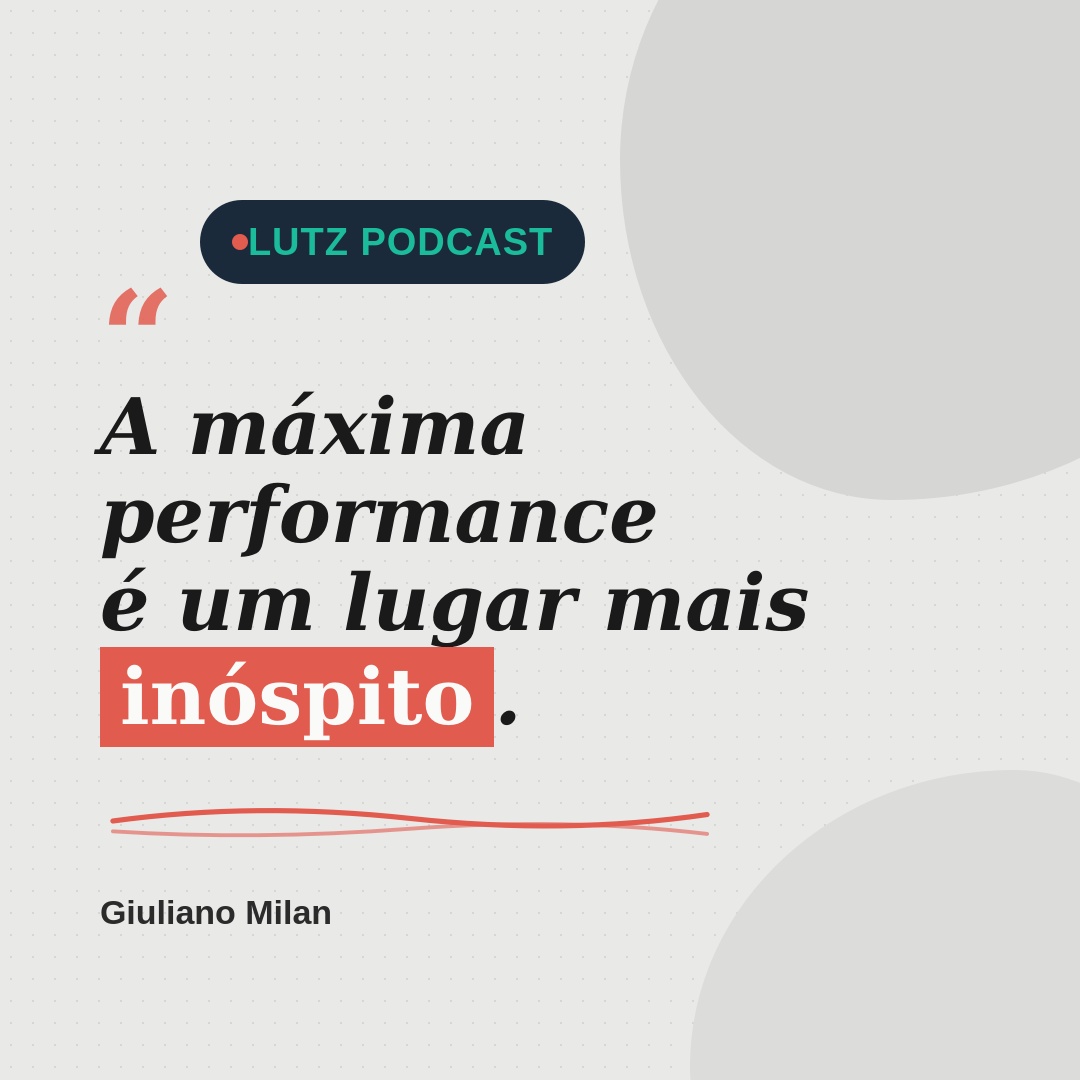
“Peak performance is an inhospitable place. The summit of Everest is not somewhere you want to spend a pleasant afternoon. The summit is not a permanent home for anyone. It’s a moment, a snapshot. Real life happens down here, day after day.”
He described elite performance as demanding and sometimes isolating, even when it brings wealth, recognition, and public admiration.
“You have to step onto the court and perform. The top can be a less human place. You may earn a great deal, have access to extraordinary opportunities, and receive applause, but you remain human. Nothing changes that.”
Chapter 6: Finding Happiness During Difficult Times
Asked to define happiness, Giuliano connected it to growth.
“I think happiness is growth: finding something to learn in everything that happens. If I go through a difficult situation, learn from it, and come out better, I’m happy. When I can’t transform discomfort and suffering into growth and maturity, that’s when I feel I’m losing.”
He also associated happiness with sharing what he has learned, including through conversations such as the podcast.
“I’m happy when I’m here sharing what I’ve learned, and I’m also happy when I’m learning. Learn and share, learn and share. That rhythm makes me happy.”
He cited Bruno Rezende as an example of how even exceptionally successful athletes face familiar human struggles.
“When people watch Bruninho on my channel, I often hear, ‘I never imagined he went through that.’ But Bruno is a human being. He has his own life and his own suffering, just like everyone else.”
Chapter 7: The Responsibility of Parenting
One of the interview’s most substantial segments focused on parenting and early childhood. Giuliano traced historical patterns, from slavery to the Industrial Revolution, to argue that society is only recently beginning to reflect seriously on how to raise future generations.
“We inherit a cycle of survival-driven brains and inadequate parenting, often because parents simply repeated what they experienced. At some point, we have to break that cycle.”
“A day in your child’s life is like more than seven days in yours. When you yell at a child, it can feel seven times louder because their brain is absorbing experiences that will shape adulthood.”
He argued provocatively that parenting should eventually be approached with greater responsibility and support, drawing an analogy to the requirements for driving.
“I think that one day having a child may require the kind of preparation we expect before someone drives a car. A child raised without care can ultimately harm far more people than a drunk driver.”
He linked this argument to concerns about anxiety, depression, suicide, and mental health in Brazil, attributing some of those challenges to early childhood experiences.
“Brazil has been described as one of the world’s most anxious countries, with serious levels of depression and suicide. I think some of that has a great deal to do with the way people are raised early in life.”
Audience Questions
In the final segment, Giuliano answered questions from viewers. Asked about meditation for autistic teenagers, he stressed that he was not a specialist in autism and recommended professional guidance, while suggesting that music might be worth exploring.
“I’m not a specialist in these conditions. Consult a pediatric neurologist. What I do see is that music can be widely accessible. It may help create a calming experience.”
Asked for book recommendations, he named How God Changes Your Brain by Andrew Newberg, Life Unlocked by Srinivasan Pillay, and The Choice by Edith Eger, describing Eger’s book as one of his favorites.
“Edith Eger’s book is wonderful, one of my top five. It shows that even after profound trauma, recovery and a meaningful quality of life can be possible.”
To close, Giuliano shared where audiences could follow his work, including Positivo Sua Mente on Spotify, Apple Music, Deezer, YouTube, Instagram, LinkedIn, and TikTok, as well as his instrumental projects Positive Mind Meditation and Positive Mind Lounge.
This interview appeared on Lutz Podcast #127, hosted by Lutz. Guest: Giuliano Milan, creator of the Milan Method for Building Presence, whose work has translated contemplative practices into practical tools for clarity, presence, and performance under pressure for more than two decades.